A data story
2%
Two percent of care leavers reach a top university by age 19.
This is a story about one of the most underrepresented groups in higher education.
SCROLL ↓
The question
Every year, thousands of young people in England leave the care system and step into adulthood without the family support most people take for granted. The state was their parent. Progression to higher education is one of the clearest tests of how good a parent it was.
This is a personal project built from two public sources: the Department for Education's Widening Participation statistics, which track progression to higher education by age 19, and UCAS data on care-experienced applicants. Together they tell a story with an uncomfortable shape. More care leavers are reaching university than ever before, and yet the gap with everyone else keeps widening the higher you look.
From the writer
These are forgotten children and young people who deserve a voice. Most likely they do not have a parent to fight for them, and often not an education to back them either. Care leavers have some of the highest rates of unemployment and homelessness of any group in the country.
I know what that gap feels like from the inside. At university, one of the things I used to do was look up how much my peers' schools had cost, because it felt unimaginable to me. Forty thousand pounds a year, just on tuition. We are doing children in care a deep injustice. How many could be at university right now if they had been given stability and the right support?
Part one
The gap widens at the top
Start with the headline. By age 19, 13 percent of care leavers have progressed to any higher education, against 46 percent of all other pupils. A care leaver is roughly a third as likely to reach university as their peers.
That gap is stark on its own, but it is not constant. Filter for high tariff universities, the most academically selective in the country, and it collapses further.
Figure 1
Care leavers vs all other pupils, by selectivity
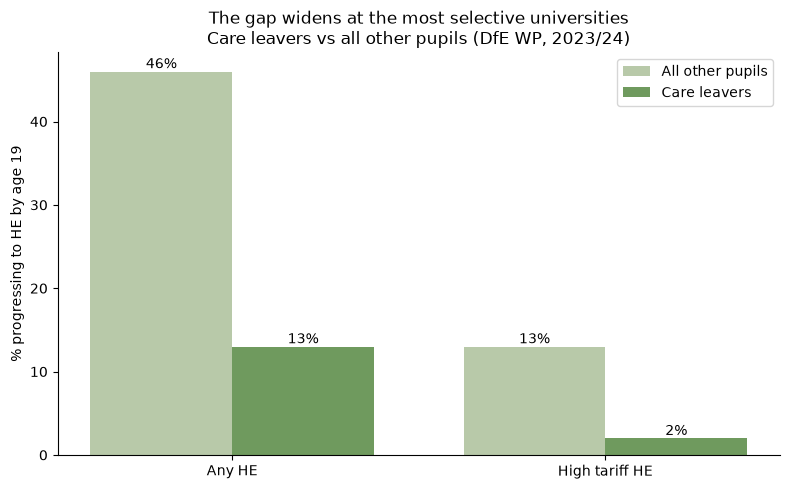
Progression to HE by age 19. Chart: Anna · Data: DfE Widening Participation, 2023/24.
High tariff progression, care leavers
2%
Just two percent of care leavers reach a high tariff university by 19, against 13 percent of all other pupils. The gap does not narrow as you climb. It widens.
The everyday gap
3.5×
All other pupils are roughly three and a half times more likely to reach any higher education by 19 than care leavers.
To put 2% in perspective: a person in the UK is more likely to be a millionaire than a care leaver is to reach a top university.
And this is not a quirk of one definition. Pupils looked after for twelve months or more sit in almost exactly the same place. Two distinct disadvantaged cohorts, tracking each other, both far below everyone else.
Figure 2
Two disadvantaged cohorts vs everyone else
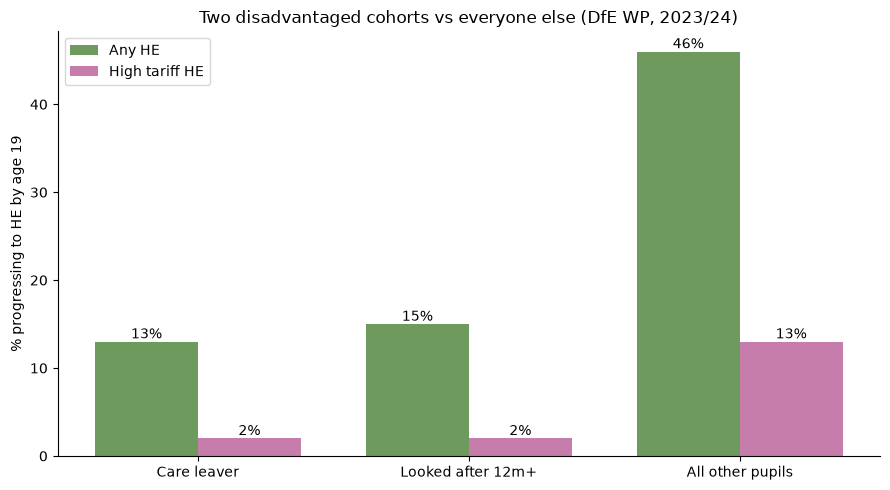
Care leavers (13% / 2%) and the longer looked-after group (15% / 2%) move together, both far below all other pupils (46% / 13%). Chart: Anna · Data: DfE WP, 2023/24.
The gap does not close as you climb toward the most selective universities. It widens to a chasm.
Part two
A decade of rising, never catching up
Here is the more hopeful reading, and it is real. Over the last decade care leaver progression has climbed from around 9 percent to 13 percent. That is genuine movement, and it deserves to be said before the harder point.
Now look at both lines together. Everyone else rose too. The distance between them barely moved. Progress has not meant closing the gap. It has meant carrying it forward.
Figure 3
HE progression over time, care leavers vs all other pupils
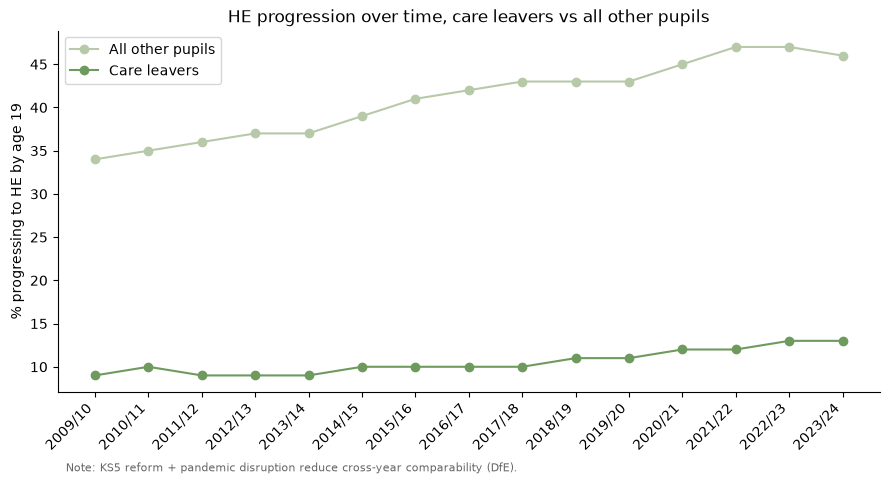
Both lines climb; the gap holds. KS5 reform and pandemic disruption reduce cross-year comparability (DfE).
The line is rising. It is just rising in parallel.
Part three
A different path to the same door
The care-experienced applicants who do reach UCAS look different from their peers in ways that matter. The clearest difference is age. Fewer arrive at the standard age-18 entry point, and far more come through their twenties and beyond.
Figure 4
Care-experienced applicants apply older
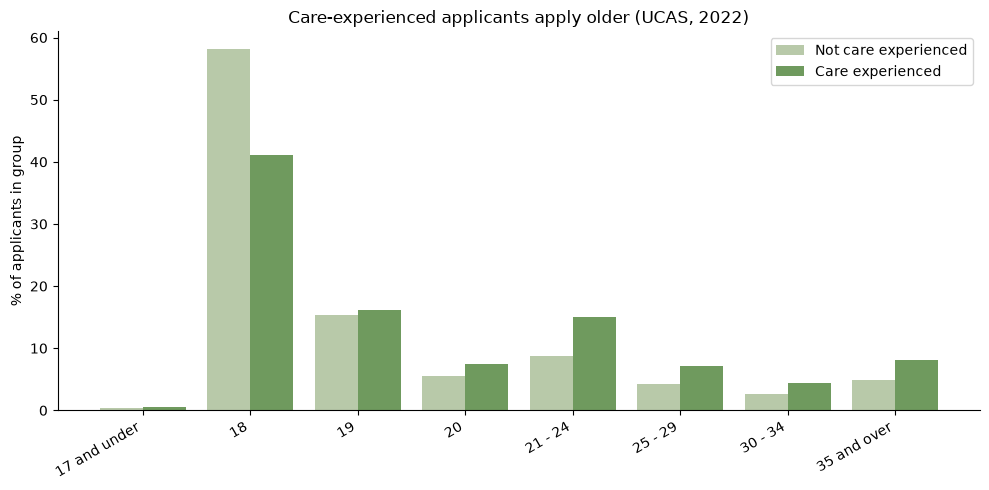
58% of non-care applicants apply at 18, versus 41% of care-experienced. The rest are spread across older age bands. Chart: Anna · Data: UCAS, 2022.
Growth in applicants, 2018 to 2022
+64%
Care-experienced applicants rose from 5,440 in 2018 to 8,930 in 2022. The pool is not just growing, the curve is steepening.
Care-experienced applicants in 2022
8,930
The demand is there and rising every year. The question is what happens to them after they apply.
Figure 5
Care-experienced applicants over time
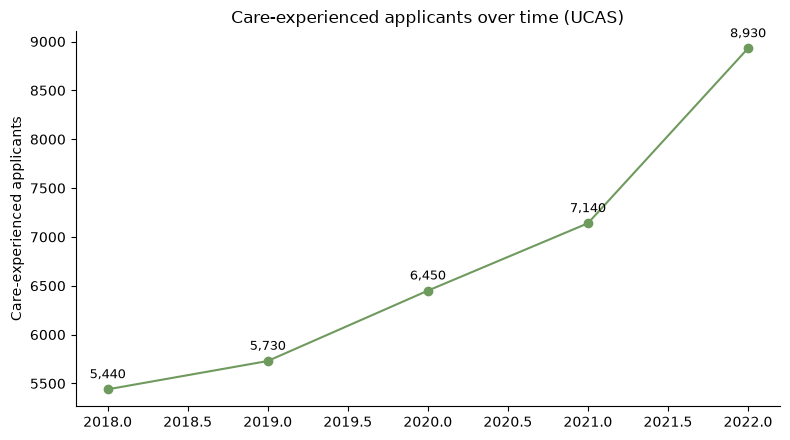
Chart: Anna · Data: UCAS.
Part four
Different qualifications, different attainment
Care-experienced applicants are more likely to arrive through routes other than the standard three A levels, leaning toward Access to HE diplomas and BTECs. The "Other" category, which captures less conventional combinations, is their single largest route in.
Figure 6
Qualification route into HE, by care status
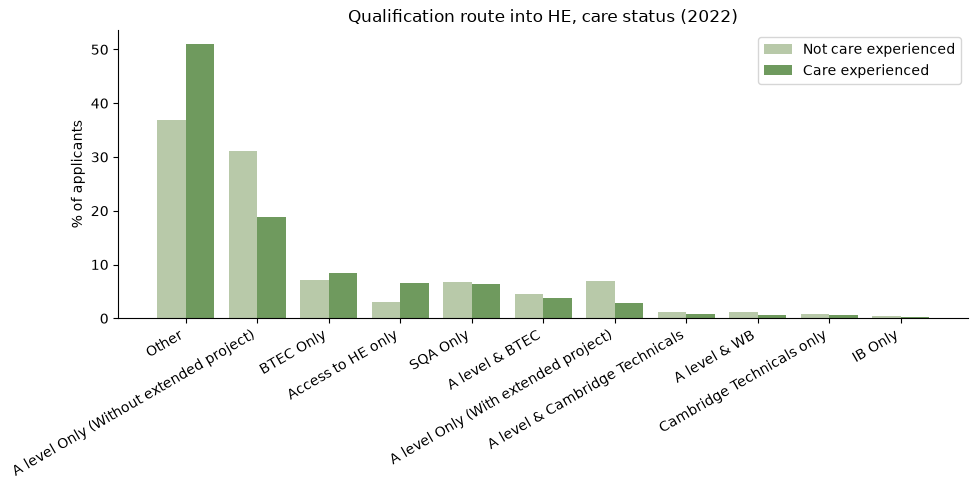
Over half of care-experienced applicants enter via 'Other' routes, versus 37% of non-care. Chart: Anna · Data: UCAS, 2022.
From the writer — this chart is my story
This chart is not abstract to me. During my GCSE years I was placed in a children's home, and they refused to let me study towards my exams. In the home's school I was only allowed to take functional skills, because it was a short-term placement. I was there a year, before being moved 300 miles away to the North of England.
I came to them with ambition and was made to feel as though I was asking for too much, or that I was not enough for wanting what most other fifteen-year-olds had a right to. When I asked for help applying for a job, I got none. Instead there was talk of helping me apply for benefits.
When I moved back to the South, I found a college and went in person to enquire, because no one supported me to apply. My personal advisor had written in my pathway plan that I was not ready to take GCSEs in such an intensive one-year format, and preferred I take a BTEC level one. I refused. I met the teachers in person, explained my situation, and was accepted. I got one of the highest grades that year, and I was not a resit student. I did it in nine months.
The journey
Where I was moved during my GCSE and A-level years
- 1Exeter, Devon
- 2Wallsend, Newcastle
- 3West Molesey, Surrey
- 4Reading, Berkshire
- 5Bracknell, Berkshire
Five placements during the years that decide GCSE and A-level outcomes, including a move of roughly 300 miles between Devon and the North East.
Among those who do take A levels, the attainment distribution is more polarised. Care-experienced applicants are over-represented at both the highest and lowest points bands, and the middle hollows out.
Figure 7
A level attainment distribution, by care status
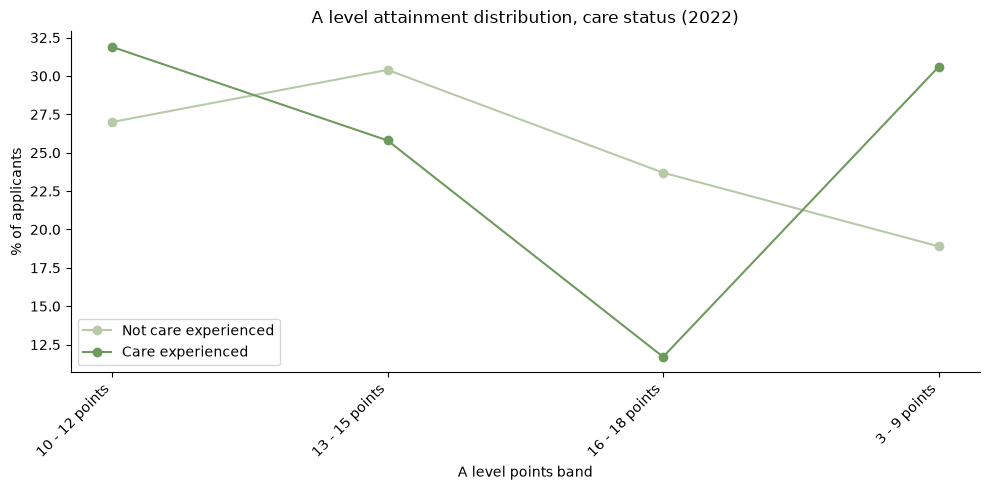
The care-experienced line is more U-shaped: stronger at the top, stronger at the bottom, thinner in between. Chart: Anna · Data: UCAS, 2022.
They are also far more likely to come from neighbourhoods with the lowest historic university participation. On POLAR4, where Quintile 1 is the lowest-participation areas, care-experienced applicants skew sharply toward the bottom.
Figure 8
POLAR4 quintile, by care status
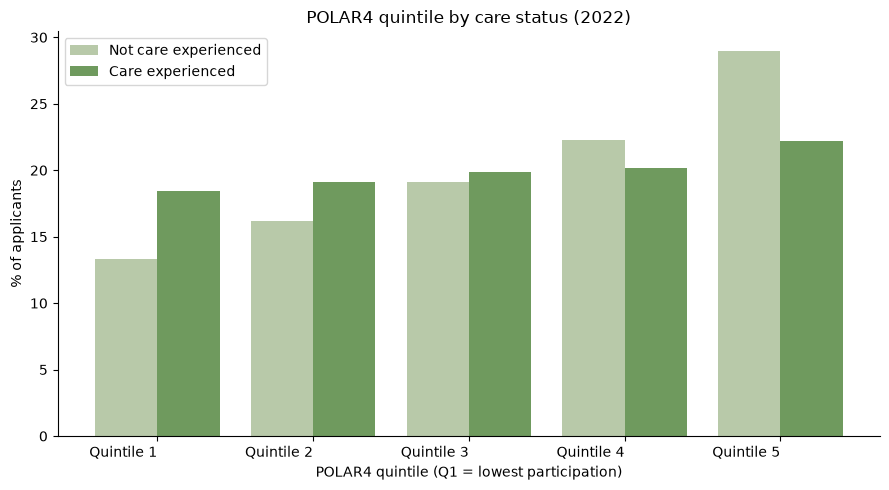
Care-experienced applicants are over-represented in the lowest-participation neighbourhoods. Chart: Anna · Data: UCAS, 2022.
Part five
"Care-experienced" is not one thing
The single label flattens enormous difference. For most applicants this was not a brief or marginal experience. Nearly half were looked after for three years or more.
Figure 9
Duration of care among applicants
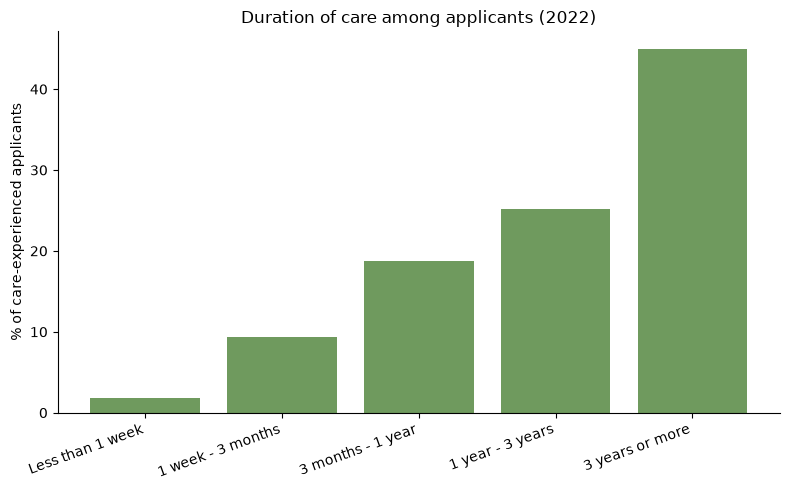
45% spent three years or more in care. Chart: Anna · Data: UCAS, 2022.
Subject choices diverge too. Care-experienced applicants lean toward nursing and midwifery, health and social care, and sociology, and away from business, engineering and economics.
Figure 10
Where care-experienced applicants differ most
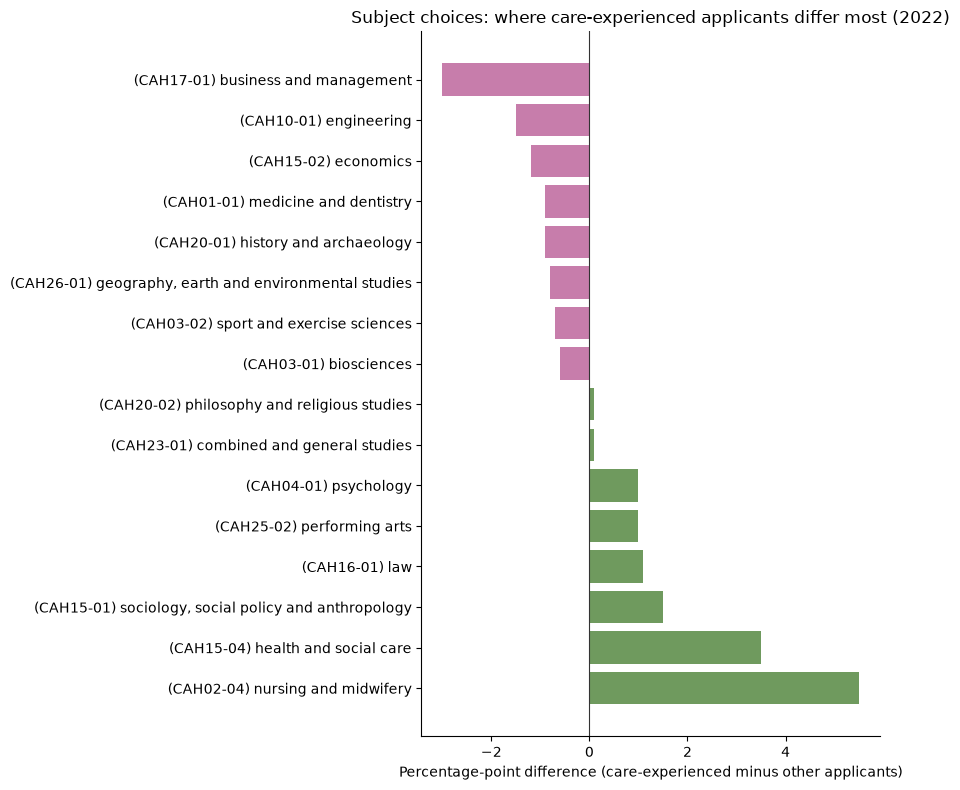
Positive bars lean care-experienced, negative bars lean toward other applicants. Chart: Anna · Data: UCAS, 2022.
Part six
What they hope for, what they fear
The last two charts are the most human. Asked what they were looking forward to, care-experienced applicants answered like anyone else: studying something they love, meeting people, a fresh start. The aspiration was never the problem.
Figure 11
What care-experienced applicants look forward to
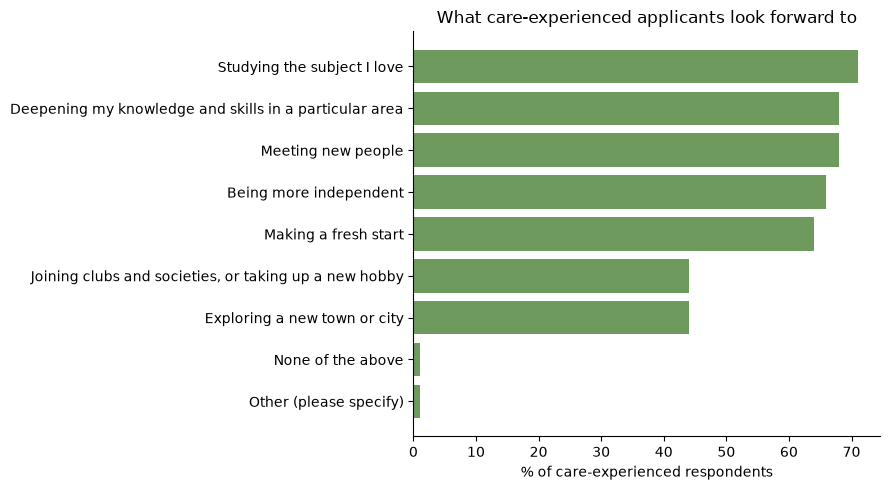
Studying the subject they love tops the list at 71%. Chart: Anna · Data: UCAS survey, 2022.
Then the other side. Their worries are concrete and structural: money first, then mental health, then friendship. Academic worry comes well down the list.
Figure 12
What care-experienced applicants worry about
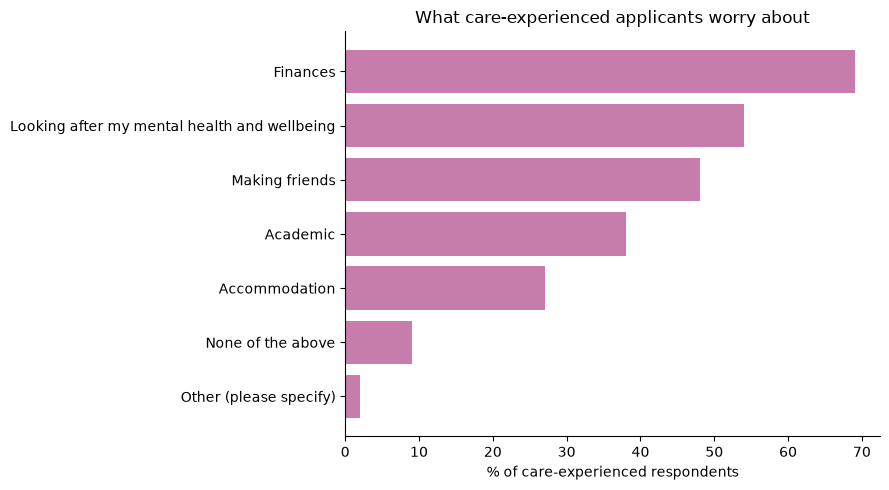
Finances lead at 69%, well ahead of academic worry at 38%. Chart: Anna · Data: UCAS survey, 2022.
From the writer — homesick with nowhere to go
The year after my GCSEs I took an Access to HE diploma. I preferred being with older students. Again I got the highest grade in my class, and the highest grade possible: forty-five out of forty-five, all distinctions. I joined the University of Bath to study Robotics.
But I neared a crisis there, because of how little support I felt. I was deeply envious of peers who could go home when they felt homesick. In a sense I felt homesick too, with nowhere to go. During a group project, my teammates asked why I was twenty in first year, and I felt so embarrassed. Had I overcome all of this just to feel demeaned? It was the first time I admitted out loud that I was a care leaver, and I did not feel good about it. I felt judged.
I am now at King's College London. How many children in care have lived the same thing and not had the voice to fight back? How many have had their dreams stepped on, their ambition diminished?
These are not worries about whether they belong. They are worries about whether they can stay.
The takeaway
What this actually says
More care leavers are reaching higher education than ever, and that progress is real. But the gap with everyone else has barely moved in a decade, and at the most selective universities it does not narrow at all. It widens to a chasm. Two percent against thirteen.
The applicants themselves are not the missing ingredient. They apply in growing numbers, arrive through harder routes, reach the very top attainment bands, and want exactly what every other student wants. What they lack is the scaffolding that lets ambition survive contact with university: money, stable housing, and someone to call.
The data describes the gap. It is on the system that raised them to explain it.
Limitations
What this data cannot tell us
The DfE and UCAS define "care-experienced" slightly differently, so the two datasets are read as complementary rather than identical. Cross-year comparisons are affected by KS5 reform and pandemic disruption, per DfE's own guidance. Survey responses on hopes and worries are self-reported and capture intent, not outcome. The Oxford figure referenced in the personal section is a snapshot, and foundation-year programmes launched recently are expected to lift those numbers in coming years, so it should be read as "as recently as 2021/22" rather than a permanent state. Charts were built in Python with pandas and Matplotlib, using a consistent green and mauve palette so the same colour carries the same meaning throughout.
About
Anna

AI and Philosophy student at King's College London. I am a care leaver, and among the small share of care leavers who reach a Russell Group university, something I hold with a lot of pride.